For most of Longboat Key's history, the pricing hierarchy was simple. Gulf-front beat bay-side. Newer beat older. South end behind the Longboat Key Club gates beat everything north of it. A buyer could look at a listing, place it on that mental map, and guess the price within a reasonable range.
That map stopped working on January 1, 2026, when Florida's deadline for fully funded condo reserves under the state's post-Surfside structural safety law took effect. The law, first passed as SB 4-D in 2022 and expanded by HB 913 in 2025, requires condo and co-op buildings three stories or taller to complete a milestone structural inspection and a Structural Integrity Reserve Study, then fund reserves to the level that study calls for. On an island where nearly every high-rise was built in the 1970s or 1980s, that deadline didn't just add paperwork. It split the market along a new line that has nothing to do with view or address: whether a building's reserve account can actually cover what its own engineers say it needs.
The document that matters more than the floor plan
Here is the friction that catches buyers off guard on Longboat Key right now. Two condos can sit in the same price bracket, carry the same square footage, and even face the same direction, and still represent completely different financial commitments once you read past the listing sheet.
The gap shows up in a document most out-of-state buyers have never asked for before: the Structural Integrity Reserve Study, or SIRS. A milestone inspection tells you whether a building's structure passed a physical exam. The SIRS tells you something more consequential: whether the association has set aside enough money to pay for the roof, the load-bearing walls, the waterproofing, and the foundation systems the inspection flagged as aging. A building can pass its milestone inspection and still be sitting on a reserve account that covers a fraction of what the SIRS says it will eventually need. That gap is exactly what triggers a special assessment, sometimes tens of thousands of dollars per unit, arriving months after closing.
Before writing an offer on any Longboat Key condo built before 2000, ask for three things: the completed milestone inspection report, the current SIRS, and the association's funding percentage against what that study recommends. Then ask what's budgeted for special assessments over the next two years. Skipping that step is how a buyer ends up owning a $700,000 condo with a $60,000 bill attached to it.
What the split actually looks like in the numbers
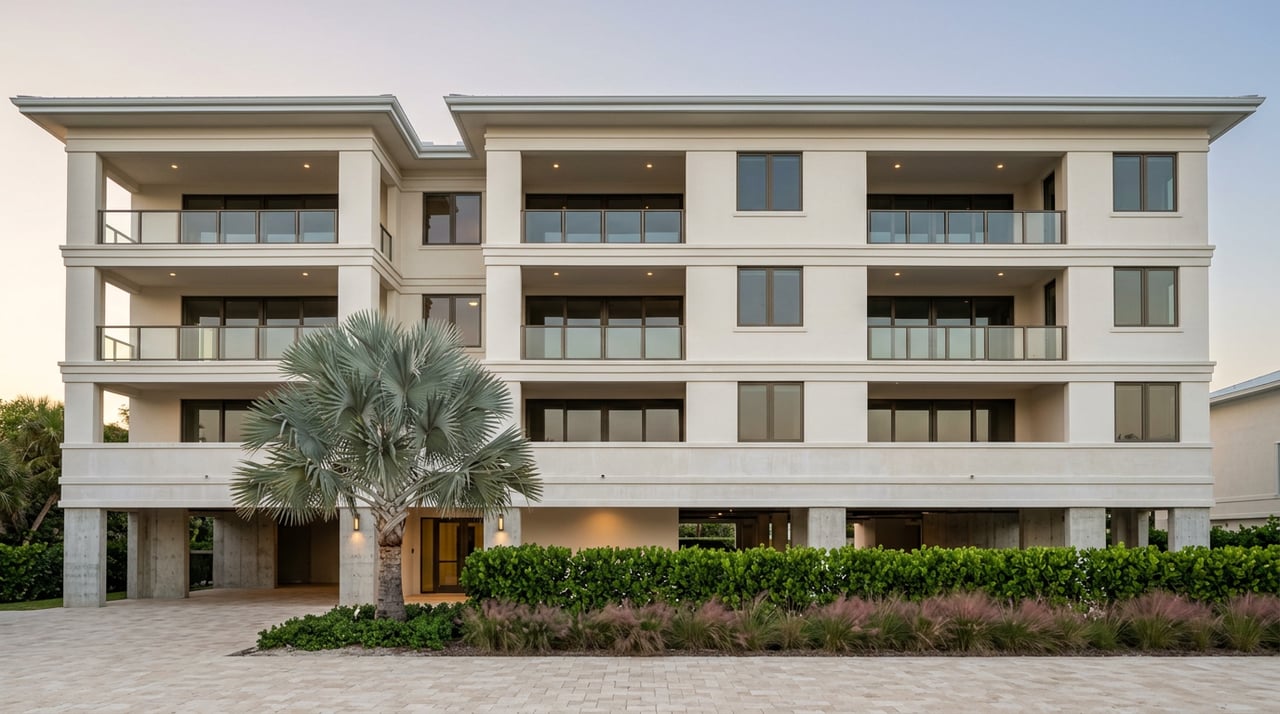
The clearest evidence that building compliance, not location, now drives price sits in recent trailing-twelve-month sales data at two of the island's newest towers. At the St. Regis Longboat Key Residences, built in 2024 on the site of the former Colony Beach & Tennis Resort, condos traded at an average of roughly $1,526 per square foot with an average of 96 days on market and a 90 percent list-to-sell ratio, in sales tracked through August 2026. At Sage Residences, another post-2020 building with fully funded reserves from day one, units traded closer to $1,043 per square foot but took an average of 232 days to sell, in sales tracked through April 2026.
Both buildings meet the same reserve standard. Both are new enough to be exempt from the anxiety hanging over 1970s and 1980s towers. Yet one is moving nearly two and a half times faster than the other. That gap says the reserve study clears a building for consideration, but it doesn't guarantee speed. Amenities, brand, and the specific slice of buyer chasing a particular address still matter within the "clean" tier. What the reserve study does is remove a building from consideration entirely for a growing share of buyers if it isn't clean, regardless of how good the view is.
Meanwhile, buildings still working through assessment cycles triggered by the new January 2026 deadline are seeing days-on-market figures running well past 100, often into the 100 to 115 day range, alongside real price reductions. That's not a soft market in the way a recession produces a soft market. It's a market pricing in a specific, quantifiable risk that used to be invisible on a listing sheet.
Passing the inspection isn't the same as passing the money test
Longboat Key has roughly 198 condo buildings that required milestone inspections under the current law. As of a March 2026 report, all of them had passed on the first round, and only two were flagged for a Phase 2 follow-up inspection. That's a genuinely good outcome for structural safety on the island.
It is also the exact place where a buyer's intuition goes wrong. A building passing its milestone inspection tells you the concrete isn't failing today. It says nothing about whether the association has the cash on hand to pay for the next twenty years of maintenance the SIRS says is coming. Those are two different tests, evaluated by two different documents, and only one of them determines whether you'll get a special assessment notice in your second year of ownership. A passed inspection with an underfunded reserve is still a financial exposure. A buyer who stops reading at "it passed" is reading half the file.
Why the buyer pool has changed shape
The people actually closing on Longboat Key condos in 2026 look different from the buyer pool of five years ago. Cash represented roughly 55 to 66 percent of condo transactions across the broader Sarasota and Manatee market in March 2026, and that share runs higher on Longboat Key itself. Short-term-rental investors, who used to treat older buildings as cash-flow plays, have been pulling back. The math stopped working once rental minimums that already run 30 days on the island, and 60 to 90 days in many gated buildings, got stacked on top of higher reserve-driven quarterly fees. An investor chasing yield can absorb one of those constraints. Both at once erases the return.
What's left is a buyer pool of people who plan to actually live in the unit, mostly retirees and second-home buyers from the Northeast and Midwest paying cash and planning to winter there for years, not renters chasing a spreadsheet. That's a meaningful shift in who you're competing against and who you're selling to, and it explains why well-reserved buildings with strong amenities are absorbing steadily while speculative-era product in older towers waits.
What to actually request before you write an offer
For any Longboat Key condo built before the current reserve standard, request these documents before your offer deadline, not after:
- The completed milestone inspection report and its date
- The current Structural Integrity Reserve Study and the reserve funding percentage it calculates against
- The association's budgeted special assessments for the next two years
- The master insurance policy, including the deductible structure
- The building's history of special assessments over the prior ten years
- Any rental restriction policy, since that affects both your resale pool and any income assumptions
Single-family homes on the island are not subject to SB-4D's reserve requirements, since the law applies to condo and co-op associations. That doesn't mean the underlying risk disappears. A single-family owner takes on direct responsibility for the roof, the seawall, and the structural maintenance that a well-funded condo association would otherwise spread across the whole building.
The island is paying attention too
The reserve conversation hasn't stayed confined to HOA board meetings. Longboat Key elected a new mayor in March 2026 after term-limited incumbent Ken Schneier reached his limit, and the town's Complete the Green initiative, which is expanding the Sarasota County library into a facility with event and meeting space, had raised more than $4 million against a $3.5 million goal as of January 2026. Longtime fixtures like Harry's Continental Kitchens, open on the island for nearly half a century, and newer additions like Whitney's, which is now pursuing a zoning amendment to expand its outdoor seating on Gulf of Mexico Drive, are still doing steady business regardless of which building tier a customer owns in. The island's daily life hasn't slowed down. What's changed is how carefully its owners are now reading the fine print before they buy in.
FAQ
Does a passed milestone inspection mean a building is safe from special assessments? No. The milestone inspection evaluates current structural condition. The Structural Integrity Reserve Study that accompanies it is the document that determines whether the association has enough money saved to pay for future repairs. A building can pass its inspection and still carry a significant funding gap that leads to a special assessment.
How do I find a building's reserve funding percentage before I write an offer? Request the current SIRS and the association's most recent reserve funding schedule directly from the seller or listing agent, ideally before your inspection period begins. Florida law gives buyers a window to review condo association documents, and the reserve funding percentage should be part of that package.
Are single-family homes on Longboat Key subject to the same reserve rules? No. SB-4D and its follow-up legislation apply specifically to condo and co-op associations. Single-family owners take on structural and roof maintenance directly rather than through a shared reserve fund.
If you're weighing a Longboat Key condo against another Gulf Coast building and want help reading a reserve study before you write an offer, iConnect RE can walk through the documents with you and help you understand what they actually mean for your total cost of ownership. Schedule a Consultation.