If you sell a house in Cape Coral this year, Florida law requires you to hand the buyer a written flood disclosure before or at the moment you sign the contract. The form is short. It asks whether you've ever filed an insurance claim for flood damage, whether you've received government or private flood assistance, and whether you know of flooding that damaged the property while you owned it. That's the entire scope. Three questions, all about water that has already come in.
Nothing on that form asks about the wall holding the canal back in the first place.
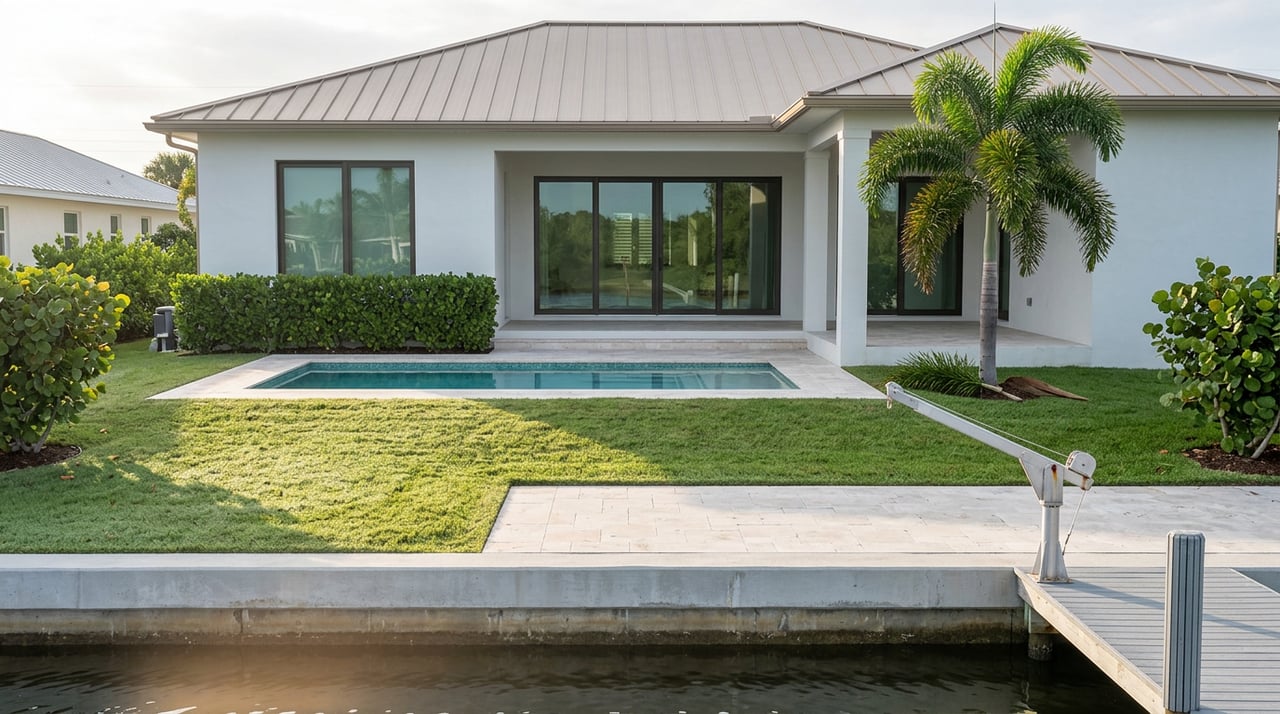
For a city built almost entirely around water, that gap matters more than it sounds like it should. Cape Coral has more than 400 miles of navigable canals, more than any other city on earth, and the city was platted back in 1957 as a waterfront community from day one. A large share of its housing stock sits on a seawall the seller has never had inspected, in a state where the property line runs to the center of the canal and the homeowner, not the city, is on the hook for maintaining and eventually replacing that wall. A seller can fill out the mandatory flood form with total honesty and still be sitting on a six-figure structural liability the paperwork never asked about.
The Law Sets a Floor, Not a Ceiling
Since October 1, 2024, Florida Statute 689.302 has required residential sellers to give buyers that written flood disclosure at or before the sales contract is signed. The state expanded the requirement again on October 1, 2025, adding separate disclosure duties for landlords and condominium developers. None of that added language mentions a seawall.
Where the statute stops, an older rule picks up. Florida courts still apply the common-law standard from Johnson v. Davis, which requires a seller to disclose known material facts that affect value and aren't obvious to a buyer walking the property. A visibly bowed or cracked wall almost certainly qualifies. A wall that looks fine from the lanai but hasn't been inspected in fifteen years sits in a gray zone that a lot of sellers convince themselves they can skip.
That gray zone is exactly where deals in this city either hold together or come apart. A buyer's insurance carrier pulls a claims history report as a routine part of underwriting a Florida policy, which surfaces prior flood claims whether the seller mentions them or not. Seawall condition doesn't show up on that report. It shows up when the buyer's own inspector puts a diver in the water during the due diligence period, which is when a seller loses the ability to control how the conversation starts.
The City's Own Math Says This Isn't a Surprise
Here's the part that should change how a seller thinks about timing. Cape Coral isn't treating seawalls as an unpredictable act of nature. It's treating them as a scheduled capital expense, the same way it budgets for roads.
In 2026, the city council approved $105.5 million in capital funding for parks, transportation, and government facilities. Buried inside that plan is $23 million for a seawall at the municipal Yacht Club, funded through $65 million in bonds authorized under Ordinance 27-26, with roughly $42 million in projected interest over the life of the debt. The city didn't fund that project because it wanted a nicer waterfront view. It funded it because a wall built decades ago has a known service life, and the bill eventually comes due whether or not anyone wants to pay it.
If the city that owns and maintains its own seawall treats replacement as foreseeable enough to bond against, a private seller claiming they had no way of knowing their 1980s-era wall might be near the end of its life is a harder argument to make in good faith.
What the Number Actually Looks Like on a Residential Lot
Seawalls are generally built to last 30 to 50 years. Past that window, replacement cost depends heavily on material and site access, but the ranges from Cape Coral marine contractors in 2026 are consistent enough to plan around.
| Wall type | Installed cost per linear foot | Typical cost on an 80 to 100 foot lot |
|---|---|---|
| Vinyl sheet pile | $400 to $650 | $32,000 to $65,000 |
| Concrete panel | $650 to $900 | $52,000 to $90,000 |
| Difficult access or full saltwater exposure | Up to $1,200+ | Up to $120,000 |
A pre-listing marine inspection, by contrast, typically runs $500 to $800 and takes under two hours on a standard residential lot. That fee doesn't make the seawall conversation optional. It buys the seller the ability to have that conversation on their own schedule, with a number they chose, instead of a number a buyer's inspector hands them on day twelve of a fifteen-day due diligence window.
The inspection itself follows a fairly standard checklist among local marine contractors: cap elevation, crack width, joint condition, and rotation measured against NAVD 88 datum. Rotation past 2 inches is generally treated as a caution flag. Past 4 inches, the conversation usually shifts from repair to full replacement. Those aren't arbitrary thresholds. They're the same benchmarks an engineer would apply if a dispute over disclosure ever ended up in front of one.
The Sequence That Keeps You Ahead of It
For an owner planning to list a canal-front home in Cape Coral, the order of operations is the difference between negotiating from strength and negotiating from surprise.
- Book the marine inspection before you list, not after an offer arrives.
- Pull your permit history for any prior seawall, dock, or lift work through the city's Permit Document Center, since buyers and their inspectors will ask, and any seawall or dock work in this city has to run through a licensed marine contractor, not an owner-builder.
- Request a current flood insurance quote, and if the property sits in a high-risk zone, price out an elevation certificate, which typically runs $300 to $600 and can meaningfully lower a buyer's premium, a number worth having in hand at the negotiating table.
- Decide, with real numbers instead of guesses, whether repairing before listing or pricing the home to reflect the wall's condition makes more sense for your situation. Either choice is defensible. Guessing at it isn't.
This matters even more for the out-of-state and seasonal owners who make up a meaningful share of Cape Coral sellers. If you're managing a sale from another state or another country, getting these steps scheduled early means the documentation is ready long before a contract clock starts running, rather than being assembled under pressure once one is.
A Few Questions Worth Settling Before You List
Does the flood disclosure form require me to state my seawall's age or condition? No. Statute 689.302 covers flooding history, insurance claims, and federal or private assistance received. Seawall condition falls under the broader common-law duty to disclose known material defects, not under the statutory flood form itself.
Who actually owns the seawall on a Cape Coral canal lot? In most cases, the property owner's land extends to the center of the canal, which makes the homeowner responsible for maintaining and eventually replacing their own wall, not the city or a neighboring association.
Can I do seawall repair work myself to save money before listing? Not the seawall or dock portion. Even an owner-builder permit in Cape Coral carves out an exception here: seawall and dock work has to go through a licensed marine contractor.
If my wall has never been inspected, am I better off not knowing before I list? Not inspecting doesn't remove the wall's condition, it just moves the discovery point later, usually into a buyer's due diligence window where the seller has far less control over price, repairs, or timeline.
A canal-front listing in this city carries a structural asset most buyers never think to ask about until their own inspector brings it up. Getting ahead of that conversation, with a real inspection and real numbers, is what separates a smooth closing from a renegotiation three days before the deadline.
If you're weighing when to list a waterfront property here, or want a clear-eyed read on what your seawall, dock, and flood history actually mean for pricing, iConnect RE has spent years walking Southwest Florida sellers through exactly this kind of decision. Schedule a Consultation and bring your questions, we'll bring the local contractor connections and the straight answers.